
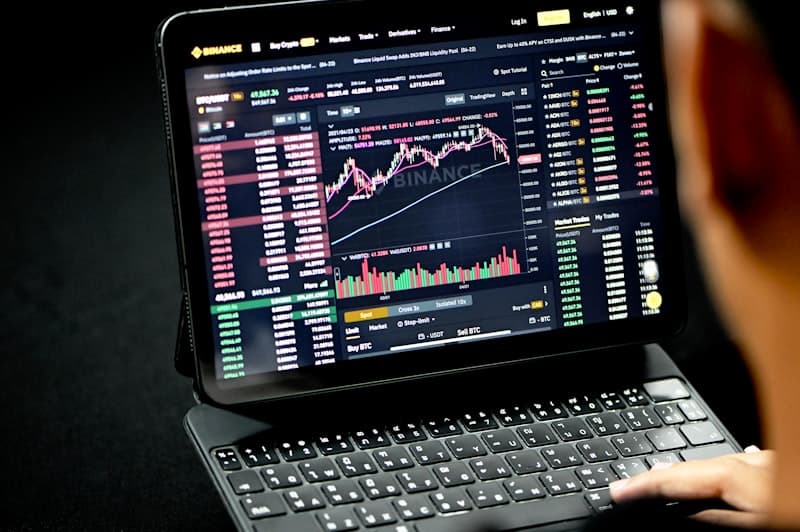
Volume‑Weighted Average Price (VWAP) is more than just another line on a chart – it is the price that institutional traders consider the true fair value for the day. While retail traders often focus on simple moving averages, the VWAP incorporates both price and volume, giving a clearer picture of where the majority of market participants have traded. In this article we break down the VWAP calculation, explain why big banks and hedge funds rely on it, and provide a practical VWAP‑based trading strategy that can be applied to forex trading, crypto trading and even prop‑firm evaluations.
VWAP is the cumulative average price weighted by volume over a specific period, usually a single trading session. The formula is straightforward:
VWAP = Σ (Price × Volume) / Σ Volume
For each bar (or tick) you multiply the typical price – often the average of high, low and close – by the traded volume, add the result to a running total, and then divide the total by the cumulative volume. Most charting platforms compute VWAP automatically, but understanding the underlying math helps you appreciate why the line reacts sharply when large volume spikes occur.
| Feature | VWAP | Simple Moving Average (SMA) | Exponential Moving Average (EMA) |
|---|---|---|---|
| Volume weighting | Yes | No | No |
| Intraday relevance | High (reset daily) | Medium (depends on period) | Medium |
| Sensitivity to spikes | Immediate | Lagged | Faster than SMA but still lagging |
| Typical use case | Institutional entry/exit | Trend direction | Trend direction |
Because VWAP reacts to volume spikes, it can diverge sharply from SMA or EMA during news releases or large institutional order flow. This makes VWAP a superior reference for timing entries and exits in fast‑moving markets.
Below is a concise, repeatable VWAP trading strategy suitable for day‑traders, prop‑firm participants and funded account holders. The approach works on 5‑minute to 1‑hour charts and can be adapted to any major pair or crypto asset.
| Condition | Long Entry | Short Entry |
|---|---|---|
| Price relation | Pulls back to VWAP after being above it | Rallies up to VWAP after being below it |
| Volume cue | Spike on the pull‑back (≥2× avg volume) | Spike on the rally (≥2× avg volume) |
| EMA confirmation | 20‑EMA also above VWAP | 20‑EMA also below VWAP |
| Time filter | Avoid first 15 minutes of the session (high volatility) | Same |
When all three conditions align, place a market order at the VWAP level. For added precision, use a limit order a few pips inside the VWAP to capture the pull‑back.
If you are trading under the Global4EX Challenge or a 1‑Phase evaluation, the VWAP strategy helps keep drawdown tight. By anchoring entries to a volume‑weighted price, you avoid chasing spikes that can inflate risk. Combine VWAP with the evaluation’s drawdown limit (often 5‑10 %) and the strategy’s built‑in risk controls to stay within the required consistency rules.
These major pairs have deep liquidity and well‑defined intraday volume patterns. Use the VWAP on the 15‑minute chart during the London and New York sessions. Notice how the VWAP often aligns with the midpoint of the range between the session high and low – a natural pivot for institutional flow.
Crypto markets run 24 hours, so reset the VWAP at a convenient time – many traders choose 00:00 UTC. Because volume can surge dramatically during news events, the VWAP line will shift quickly, offering clear entry points when price reverts to the weighted average after a breakout.
Gold’s volatility spikes during macro‑data releases. By overlaying VWAP on a 30‑minute chart, you can spot whether the market is buying above the fair value (bullish) or selling below it (bearish). In a prop‑firm context, the MyFinancial Pro tier often allows larger position sizes, making VWAP‑based entries especially attractive for scaling.
VWAP offers a transparent, volume‑aware benchmark that institutional traders have trusted for decades. By integrating VWAP with a simple EMA filter, volume spikes, and disciplined risk management, retail traders can mimic the same fair‑value approach used by banks and hedge funds. Whether you are trading EUR/USD, GBP/USD, BTC/USD or XAU/USD, the VWAP strategy provides a clear framework for entries, exits and drawdown control – essential ingredients for success in a prop firm environment.
When comparing the best prop firms in 2026, look for flexible evaluation rules, low drawdown limits and fast payouts – features that Global4EX delivers through its Challenge, 1‑Phase, 2‑Phase, and HFT Instant programs. Applying the VWAP playbook on a funded account such as MyFinancial Pro can help you achieve consistent performance while staying within the evaluation’s risk parameters.
Published by the Global4EX Team. Learn more at global4ex.com
Join Global4EX where traders unite, grow, and get rewards.
Join NowAll information is provided "as is," without warranties of completeness, accuracy, timeliness, or results, whether express or implied. Users are solely responsible for evaluating the risks and benefits associated with the use of this website's content.
Payments made to access simulated challenges are not deposits, investments, or client funds, but subscription fees for participation in evaluation programs and educational materials. All fees collected are allocated toward operational expenses, including but not limited to personnel, technology, and business infrastructure.
The information provided regarding simulated challenges is intended solely for educational purposes related to trading practices. It does not constitute investment advice, financial services, brokerage services, business recommendations, investment opportunity analysis, or general recommendations regarding trading financial instruments.
It provides simulated evaluations using data feeds from reputable brokers and platforms solely for the purpose of educational and training simulations. No real trading activity or execution of financial transactions takes place on behalf of participants.
This website and its content are not intended for residents of jurisdictions where its distribution or use would contravene local laws or regulations.